
 Culture
 GAA Explained for Brazilians — Ireland's National Sport
5 min read
The GAA — More Than a Sport, More Than a Club
Within a few weeks of arriving in Ireland, you will hear people talk about GAA. You'll see county flags hanging from windows, hear names like "Croke Park" and "All-Ireland Final" spoken with reverence, and watch otherwise mild-mannered Irish people become intensely passionate about a team wearing their county colours. The GAA — Gaelic Athletic Association — is unlike any sporting organisation in the world, and understanding it will help you understand Ireland.
What Is the GAA?
The Gaelic Athletic Association was founded in 1884 with the goal of preserving and promoting Irish culture, language, and sport. It governs three Gaelic sports: Gaelic football, hurling (and its women's equivalent, camogie), and handball. The GAA has over 2,300 clubs across Ireland — and hundreds more around the world, including in Brazil.
What makes the GAA remarkable is that it is entirely amateur. The players — some of the finest athletes in the country — receive no salary. They train four or five nights a week, travel long distances for matches, and compete at the highest level purely for the love of the game and their county. This ethos of community and loyalty is at the heart of why Irish people are so passionate about it.
Gaelic Football — The Game You'll See Most
Think of Gaelic football as a hybrid of football (soccer), rugby, and basketball — but invented completely independently of all of them. It is played on a large grass pitch between two teams of 15 players. The goal is to score by kicking or punching the ball over the crossbar (worth 1 point) or into the net below it (worth 3 points, like a goal).
Players can run with the ball but must bounce it on the ground or kick it to their own hand every four steps. They pass by punching or slapping the ball to a teammate — you cannot throw it like in American football. Unlike in soccer, you can pick the ball up off the ground. Unlike in rugby, you don't need to pass backwards.
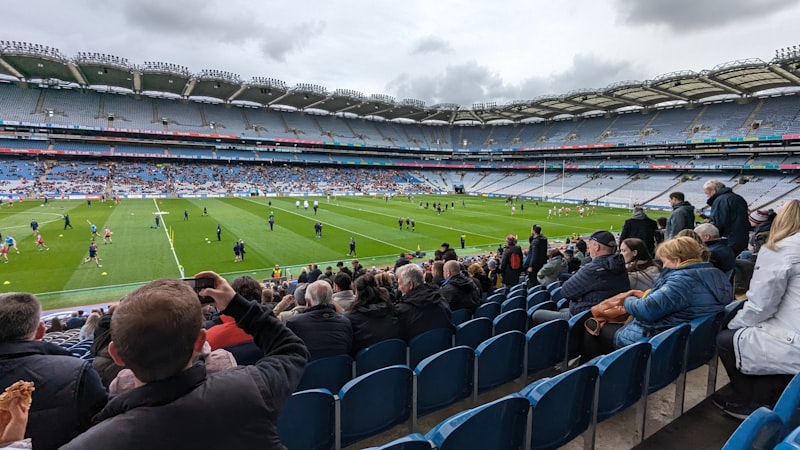
For a Brazilian watching for the first time, the pace is striking. Matches move fast, the score changes rapidly, and the physicality — shoulder-to-shoulder challenges are allowed; grabbing a jersey is not — can surprise you. A county championship match on a summer Sunday afternoon, with a few hundred locals cheering at a local ground, is one of the most authentic Irish experiences you will have during your exchange.
Hurling — The Fastest Field Sport in the World
Hurling is older than Gaelic football — it has been played in Ireland for at least 3,000 years — and many people who see it live for the first time consider it the most impressive field sport they have ever watched. It is played with a wooden stick called a hurley (camán) and a small leather ball called a sliotar.
The sliotar travels at up to 150 km/h. Players can carry it balanced on the hurley while running, flick it between hands, or strike it on the ground or in the air. There is no other game quite like it. International sports journalists have repeatedly called hurling the most skilful field sport in the world. If you get the chance to see a match live, take it — even if you don't understand the rules yet, the spectacle alone is worth going for.
The women's version, camogie, follows nearly identical rules and is played at the same intensity and skill level. County camogie matches often have a passionate local following and are underrated as a spectator experience.
The County System — Why It Matters So Much
In Ireland, GAA loyalty is organised by county, not city or club. When someone says "I'm a Dub," they mean they support Dublin GAA. When they say "come on Kerry" or "come on Galway," they are talking about a county team. Understanding this is key to understanding how Irish people talk about sport.
Unlike in Brazilian football, where clubs like Flamengo or Corinthians have national followings that cut across states, GAA county teams draw players exclusively from within that county. A Dublin player cannot play for Cork. This creates fierce regional pride — and genuinely heartbreaking losses, because losing the All-Ireland Final for a county that has waited 30 years is not a small thing to the people watching.
The biggest event in the GAA calendar is the All-Ireland Football Final and the All-Ireland Hurling Final, held each September at Croke Park in Dublin — the fourth-largest stadium in Europe with an 82,300 capacity. Tickets are hard to come by unless you have a connection to one of the competing counties, but if you are in Dublin in September, the atmosphere across the entire city on final weekend is unlike anything else you will experience during your exchange.
Where to Watch and How to Get Into It
You do not need tickets to a big match to enjoy the GAA. Here is how to start:
- Local club matches: Free or €5–10 entry to local and county championship matches. Ask your Irish classmates, your homestay family, or your school staff which local club plays nearby. Most Dublin suburbs have a GAA ground with matches on weekends from March to September. These local matches are the soul of the GAA — not the big televised finals.
- Croke Park stadium tour: Even without a match, a guided tour of Croke Park (€15–20 for students with ID) is genuinely worth it. The stadium houses a museum tracing the GAA's history from its founding through the War of Independence — including the 1920 Bloody Sunday massacre, when British forces opened fire on spectators and players at the ground. It is deeply woven into Irish history.
- Watch it on free TV: RTÉ (Ireland's public television channel, available free over the air and online at rte.ie) broadcasts major GAA matches. Watching an All-Ireland quarter-final in a pub surrounded by Irish people supporting their county is an experience worth seeking out.
- GAAGO app: For matches not on free-to-air TV, GAAGO is the official streaming platform. Some games are behind a paywall, but many championship games are available free or at low cost.
The GAA and Irish Identity
For Brazilians, futebol is the closest cultural equivalent — a sport so woven into national identity that it shapes how people talk, celebrate, and grieve. The GAA occupies a similar place in Ireland, with one important difference: it is also explicitly a cultural and political project. Founded in the shadow of British rule, the GAA was part of a broader Irish cultural revival. For much of its history, members of the British security forces were banned from joining. Until 2005, the rules even prevented foreign sports — rugby and soccer — from being played at Croke Park.
When that rule was lifted and Ireland played England in a rugby international at Croke Park in 2007 — with the English national anthem played at the same ground where British forces had killed Irish spectators in 1920 — it was one of the most emotionally significant moments in modern Irish sporting history. Many Irish people cried. Knowing this context is not required to enjoy a Sunday match at a local GAA ground, but it helps you understand why the person sitting next to you cares so deeply about a game.
How Departi Can Help
Understanding Irish culture — the GAA, the slang, the history — makes your exchange richer and your friendships with Irish classmates easier. Departi's community connects you with other Brazilian students who have already been to their first GAA match and can tell you which county to support, which ground to visit, and how to explain hurling to your family back home on a video call.
Packing for Ireland — What to Bring and What to Leave
Ireland is not Canada — but it's not Brazil either. A practical packing guide so you don't arrive freezing in a summer dress or dragging a suitcase full of things you'll never use.